
Class A Surfacing
Flawless, curvature-continuous surfaces for visible parts.
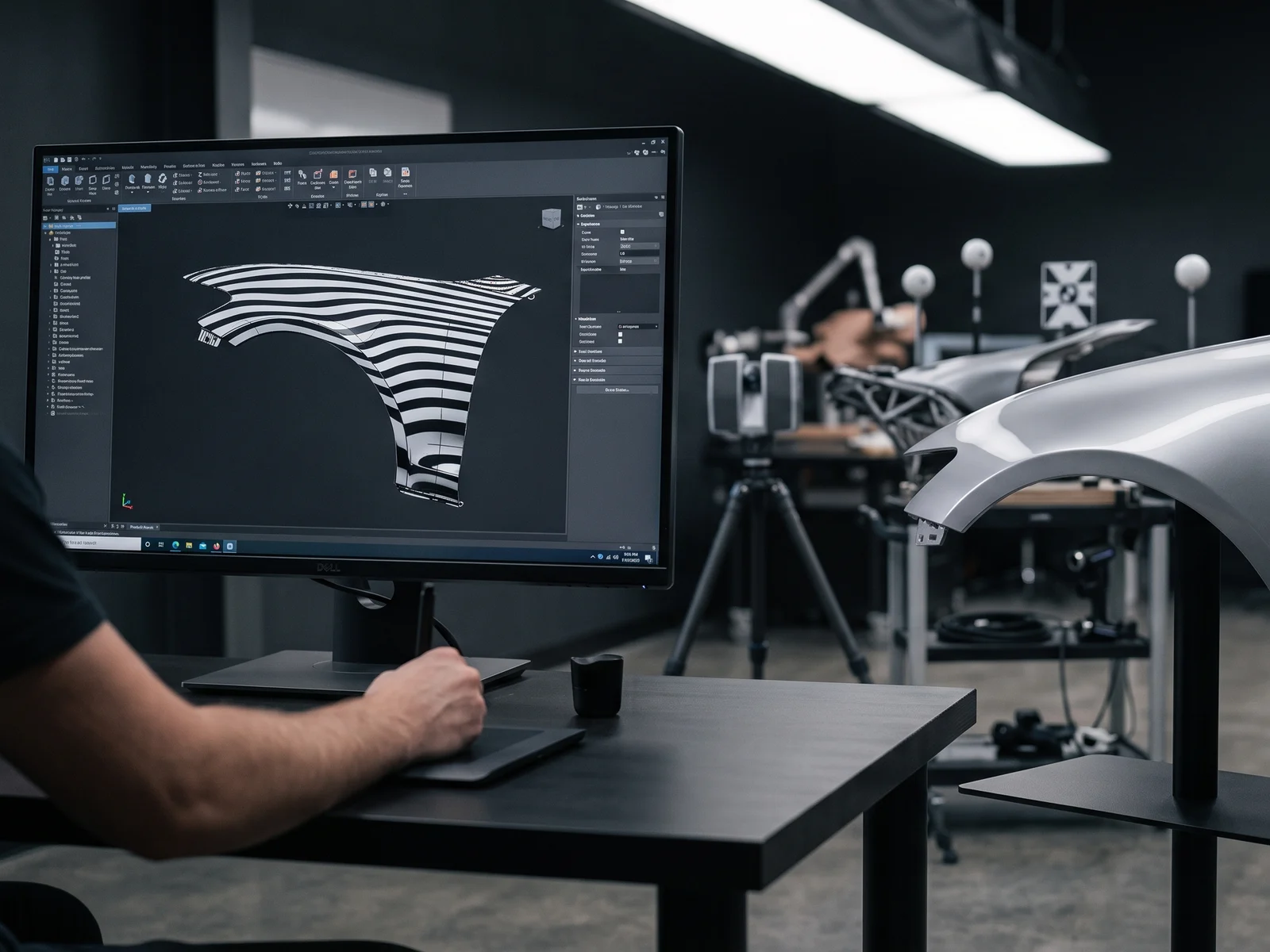
Class A surfaces are the visible skins of a product — car body panels, aircraft fairings, consumer-product housings. We build G2/G3-continuous surfaces with clean patch layouts and verify them with zebra and curvature analysis, so reflections flow without a ripple.
G2 / G3 continuity
Curvature-continuous transitions between every patch for perfect reflections.
Analysis-verified
Zebra stripes, highlight lines and curvature combs checked on every surface.
From scan or sketch
Start from a clay-model scan, a reference surface or concept sketches.
Tooling-ready
Surfaces handed over with draft, flanges and offsets ready for engineering.
Four steps, no surprises.
- 01BriefTell us about the part, product or space and what you need from class a surfacing.
- 02Capture & modelOur engineers scan, model or prepare your data with the right tools for the job.
- 03ReviewYou check the result against your requirements; we refine until it is right.
- 04DeliverFinal files, parts or reports delivered in the formats your team uses.
Class A Surfacing projects.
Class A Surfacing FAQ.
Can you create Class A surfaces from a 3D scan?
Yes. We scan the physical model or part, then build new Class A surfaces that follow the scan within an agreed tolerance, with clean G2/G3 continuity.
What's the difference between Class A surfacing and reverse engineering?
Reverse engineering focuses on accurate, manufacturable geometry. Class A surfacing adds strict control of surface continuity and reflection quality for visible surfaces.
Which file formats do you deliver?
Neutral formats such as STEP and IGES, which open in CATIA, NX, Alias and other platforms.
Have a part, a building or an idea?
Tell us what you need — we usually reply within one working day.